

#163. Spinning negative thoughts into gold
Notes on neuroticism, plus the millennial ten commandments

84% of Gen Z thinks we have a mental health crisis in the United States. There’s a joke right now that everyone you know is going back to school to be a therapist, and I can’t tell you how often I talk to people who are seriously thinking about it or have decided against it because of the time it takes to get licensed. Jobs in mental health are rising “much faster than average,” and by the time I start practicing as a fully licensed counselor in roughly six years, a majority of the clients I will probably see, given my proposed speciality, are younger millennials and Gen Z.
Gen Z, as a generation, is especially prone to neuroticism. You’ll find neurotic people in every generation, but the ill-timed combo of social media, late-stage capitalism, and a global pandemic knit together the perfect storm to really nail people who are currently 14-29 years old with a tidal wave of anxiety. Only time will tell what happens to Gen A.
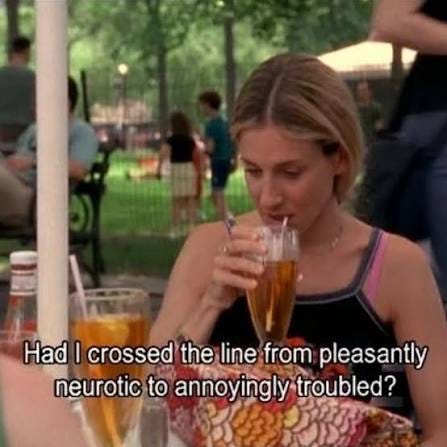
Neuroticism is a tendency towards negative thoughts and emotions. It can look like a lot of different behavioral or personality quirks, like Carrie Bradshaw overanalyzing every little thing Mr. Big ever said (and sabotaging her relationship with Aidan!!!!) or Blair Waldorf constantly plotting revenge against her friends. Highly neurotic people are prone to blowing small things way out of proportion, seeing major threats where there are really minor issues. I get 100x more neurotic for a few days during my luteal phase and I absolutely hate it.
But do the issues that Gen Z worries about actually qualify as minor? Life stability in adulthood unfortunately begins with the ability to make money, and Gen Z has higher unemployment than any other generation. Peruse a few anecdotes online and you’ll see words like apocalyptic, catastrophic, and dismal being used in reference to today’s job market, especially for people under 30. Can we really blame Gen Z for worrying so goddamn much when it’s this hard to find a job and we’re all slowly boiling to death?
“I think there is just an overarching fear of failure or making mistakes or making the wrong turn in their career trajectory that would emotionally or physically set them back years. And so I think that anguish is just an anchor that’s holding [Gen Z] back.”—VICE
Millennials are dealing with a slightly different but related problem. We were sold the idea of the “AmErIcAn DrEaM” by our rich boomer parents: Go to college, get a degree, build a safe, respectable career in a 9 to 5 office job that would allow us to buy a home by the time we turned 30. You’ve heard this all before because this is the script we grew up with, like our generation’s ten commandments:
Thou shalt go to college.
Thou shalt strive for academic success to ensure a stable job upon graduation.
Thou shalt chain thyself to a desk chair 40+ hours a week until retirement.
Thou shalt be grateful for the career opportunities thy mother was not afforded.
Thou shalt “lean in,” climb the corporate ladder, and become a girlboss.
Thou shalt marry, not too early or too late.
Thou shalt buy a house in the suburbs.
Thou shalt balance both a career and 2.5 children.
Thou shalt not complain about exhaustion or overwork.
Thou shalt retire with a fat 401K.
Gen Z watched the millennial dream die like a car crash in slow motion. They witnessed the demise of the girlboss era, eyes wide with horror, and realized that a college degree followed by a 9 to 5 corporate career was no longer a guaranteed safety net long before many millennials did. What millennial woman do you know who hasn’t experienced a career/relationship/parenting/financial/friend crisis in the past few years??? Among other things, like not drinking or having anywhere near as much sex as we did, Gen Z has embraced the gig economy as a protective measure. They’ve been in preparation mode for years at this point, selling clothes on Depop, doing social media/videography for small businesses and brands, and influencing on TikTok. No wonder they fear failure. They don’t want to end up like us.
Millennials grew up on a steady diet of fabulously neurotic women in film and TV, but their character arcs almost always illustrated how to outgrow our worst habits. Carrie Bradshaw finally learns how not to sabotage all her romantic relationships and marries Mr. Big. Her best friend Charlotte York, forever an uptight romantic obsessed with finding “the perfect man,” eventually finds happily ever after with a short, sweaty bald guy. Blair Waldorf learns how to stop seeking revenge on everyone who has ever done her wrong and marries Chuck, who always loved her for exactly who she was, neuroses and all. The list goes on, but the point was always to show us how we, too, can chill out a bit and finally find some peace.
Personally I blame social media for the way that Gen Z seems to collectively wear their anxiety like a badge of honor. Gen Z grew up with social media in a way that most millennials did not. We (I) spent most of our screen time watching DVDs of Grey’s Anatomy and posting blurry pics of house parties on Facebook. I got a Facebook account my senior year of high school (back when it was 0% video content) and Instagram followed right before I graduated from college. The oldest members of Gen Z were only 19 when Instagram Stories changed everything about social media as we knew it (thankfully I was 27 with a fully formed prefrontal cortex) and they were 23 when TikTok hit the mainstream in the U.S. I guess it’s not a surprise that 57% of Gen Z want to be influencers.
But TikTok influencers don’t have transformative character arcs. Some influencers constantly make you feel like you’re missing out on something fundamental, and others normalize feeling bad. Have you heard of the “loneliness influencer” yet? Millennials would never.
Neuroticism isn’t a mental health diagnosis, but it’s linked to both anxiety and depression. If you tell yourself every day that you’re an unimportant cog in the capitalist machine who probably doesn’t deserve to find a stable job you love or buy a house someday and also it doesn’t matter anyway because this country is run by a crazy person and the world is burning down and the life you want will just never happen, it probably won’t. You are your thoughts. Your thoughts become your reality. That’s neuroticism doing its dirty work.
So these days I’m trying to repeat to myself every single day that being let go from my last job was the best thing that could have happened to me when it did, because it forced me onto the career path I’m on now, which will be a much better fit for me in the long run. Marketing is a young person’s game. I can practice therapy until I’m dead. My parents chose my first career for me; I’m choosing my second. Over time, the idea that I am actually better off now is slowly becoming my reality, inch by every glorious fucking inch.
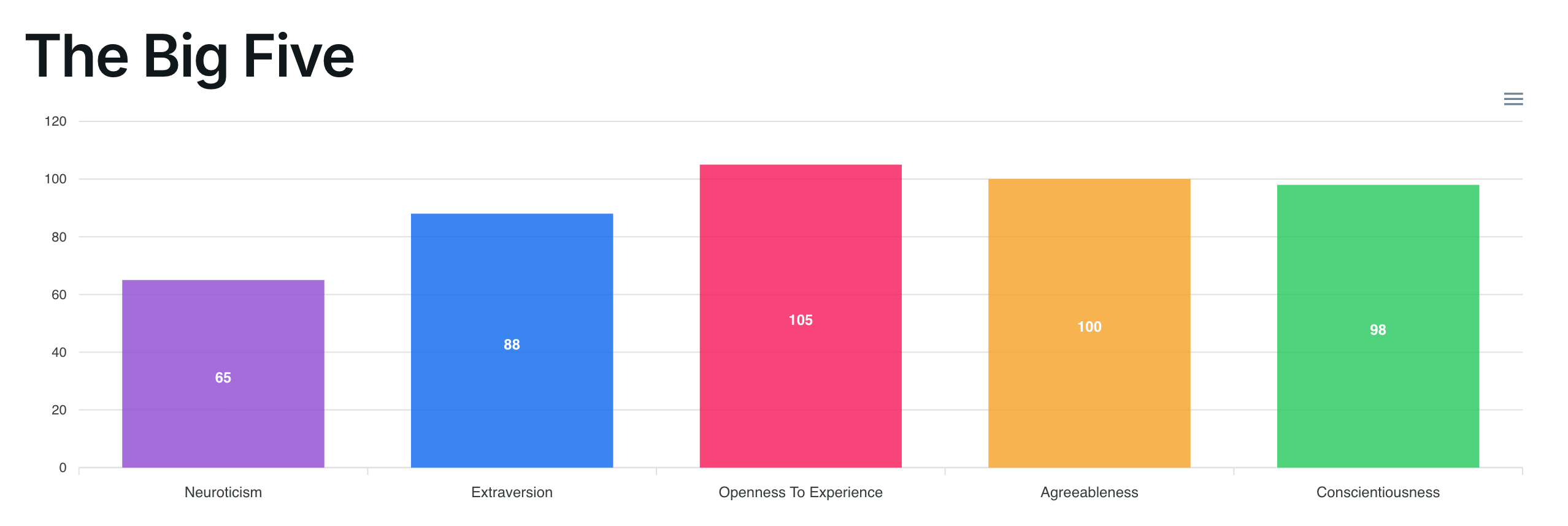
I took the Big Five test recently to see where I currently land on neuroticism (the purple bar above). My overall score was low, but my “anxiety” score (one of the dimensions that goes into calculating neuroticism) was high, and “anger” and “depression” were both medium. All of this tracks in exactly the way I thought it would. My anxiety runs in direct correlation to my worries about money and my fears about the economy. And despite my best efforts, I have not yet completely let go of the fact that I am still a liiiiiiitle bitter about how impersonally I was treated when I was let go from my last job, especially after seven years of stuffing millions of dollars in my bosses’ shiny pockets and genuinely feeling like we had a great relationship. Of course I feel a little depressed that I have to go back to school again to get my life back on track, because depression is anger turned inward. Wouldn’t you?
But now I’m trying my damndest to reframe all of that and focus on the abundance of positive things in my life. Every day I’ll take all the negative thoughts that creep in and spin them into gold. Not to be the person who always has the perfect Taylor Swift song for everything (😈) but:
All that time you were throwing punches
It was all for nothing
And our town, it looks so small from way up here
Screamed, “Thank you, Aimee” to the night sky
And the stars are stunning
‘Cause I can’t forget the way you made me heal
Everyone knows that my mother is a saintly woman
But she used to say she wished that you were dead
So I pushed each boulder up that hill
Your words were still just ringing in my head, ringing in my headThank you, Aimee

This week’s POP TUESDAY was ranking all of Taylor Swift’s songs that were specifically written for movies. I feel like you can probably guess my #1 and it isn’t “I Knew It, I Knew You.”
And in last Sunday’s FREAK WEEKLY!, I bought a Gap top that looks like DOEN if you’re into that kind of thing (I certainly am)
Part of the Z’s jobless problem stems from the lowest ever rate of teenage employment. Those teenage jobs are where young people learn lifelong job skills including how to search for and interview for a job. Why is the teenage job rate so low? A big reason is the huge increase in the minimum wage in many cities (going to $30/hr in CA). Employers can’t afford unskilled teenagers at that rate and so turn to automation or shut down. This disappearance of low wage first jobs is a real problem for that generation’s future.